Kamana Naturalist Training Program

The Kamana Naturalist Training Program is a deeply transformational, four level, nature connection journey and learning experience designed to take you down a path that will prepare you to be a skillful and fierce naturalist.
The Kamana Path has two trails, the Awareness Trail and the Resource Trail, and each trail has many tracks. The Kamana Trails intertwine as they expand and deepen awareness in the field, and sharpen it through journaling and sketching work with bioregional field guides and other resources.
Jon Young began researching what was later to become Kamana in 1979. Between 1979 and 1983, Jon shared his findings and ideas with Tom Brown, Jr., Jon's mentor since 1971. Tom had been mentored by an Elder Apache named Stalking Wolf, or Grandfather in the same way Tom mentored Jon. This was the foundation of Kamana emerging. Jon further researched other traditional hunter-gatherer groups on five continents and found the same pattern of mentoring and connection.
Upon graduation from University, Jon started his first mentoring program under the name Wilderness Awareness School. During this time, Jon continued to collaborate with his mentor, Tom Brown, Jr. and, the two were joined by Elder Ingwe to create the original learning and connection pathway that a few years later was given the name Kamana by Ingwe.
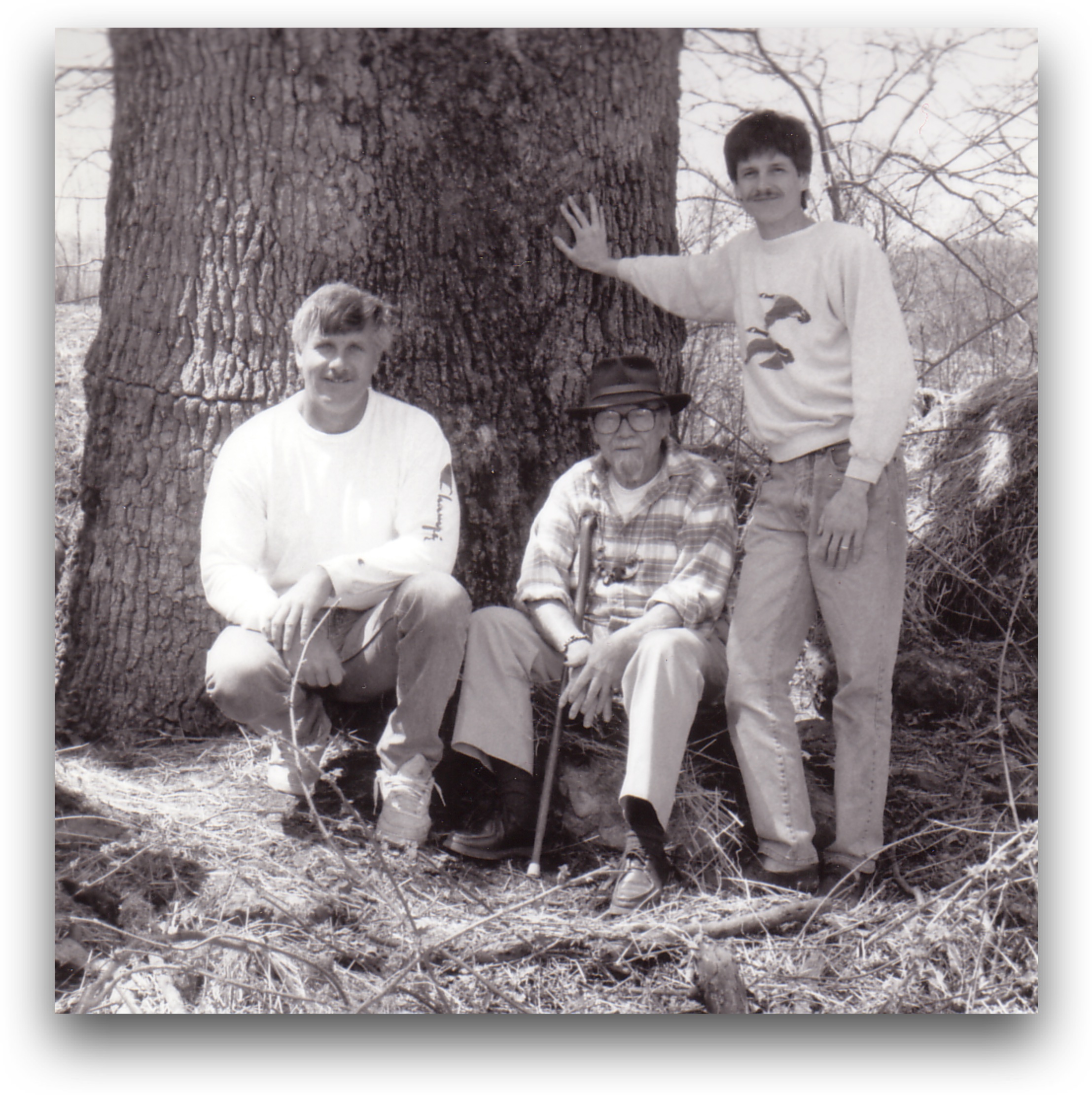
Tom Brown Jr., Ingwe, and Jon Young (1992 at the Tracker School in Asbury, NJ)
The name Kamana was chosen by Wilderness Awareness co-founder Ingwe (M. Norman Powell, 1914-2005). From 1920, when Ingwe was just 6 years old, his family moved from South Africa to Kenya near Mount Kilimanjaro. The only neighbors by their wilderness farm were the Akamba People, a hunter-gatherer and semi-nomadic tribe. One family among the Akamba were quick to adopt Ingwe and he grew up speaking more Kikamba (the Akamba language) than English.
The word 'kamana', according to Ingwe, is from the Kikamba language, the people who Ingwe spent his childhood with as adopted family. Again, according to Ingwe, the word means "the initiate", or "those who carry the burdens of the Warriors ('anake' in Kikamba) to demonstrate their worthiness to become Warriors in the future".
Ingwe expressed with certainty, and tremendous urgency, that the Earth greatly needs Warriors to Protect and Care for Mother Earth on behalf of the Future Generations.
As such, Ingwe was also convinced that the "burden" to be carried by the initiates is to learn deeply about, and to connect deeply with the natural world so as to be a person who can powerfully, and with wisdom, care for Mother Earth.
Click the image below to listen to a free audio recording from Jon
We understand that there have been concerns around the cultural collaboration that went into the development of the Kamana program.
We are sensitive to this, and we also highly value, and continue to deeply honor, the people who generously contributed their wisdom with the clear and strong intention that it be shared to benefit the whole, and to be passed forward to the Future Generations.
We are working on a re-write to clarify and honor the cultural relationships involved in the creation of the Kamana program, as well as to update the science.
Until then, we are making the current version of Kamana available here, in response to the many requests we have received to have access to the program as it is.
The Kamana Naturalist Training Program will be re-titled to reflect the changing needs of our times. The integrity and value of the Kamana Graduation Certificate will be maintained at a high level, and for the first time in many years, Kamana Four Certificates of Completion will be signed by Jon Young.
We are now accepting donations to help fund the re-write of Kamana, the re-record of Seeing through Native Eyes, and other related projects
Kamana One is accompanied by an audio program by Jon Young. The first edition of Seeing Through Native Eyes audio program was based on the original 6 Shields framework. This edition was recorded and published in the mid-1990's with a subtitle of Understanding the Language of Nature. The second edition is based on an 8 Shields framework, was published in 2014, and called Seeing through Native Eyes: The Journey of Connection.
Both editions are popular with people feeding back to us that they listened to the First Edition literally hundreds of times over!
We are aware of how the name Seeing Through Native Eyes may be, and has been, interpreted as offensive. This fall (2023) we are re-naming and re-recording the audio series.
The term 'native' as used in the recording refers to the knowledge and connection one would have if they were raised in a traditional subsistence-based culture, living close to the land, juxtaposed to a person who is—due to lack of connection, knowledge and experience—functionally "alien" to their ecosystem.
The wisdom in the audio series is intended to bring a person, regardless of race or culture, into deep relationship with the land, the wild beings, elements, and all other aspects of the natural world, as is the birthright of all.
Click the image below for more information
Kamana One ~ is a short experiential journey designed to create an on-ramp to the routines and activities that will connect people to nature in their own backyard and surrounding landscape. Additionally, this course-book sets up effective journaling techniques necessary for the deeper Kamana Naturalist Training Program starting with Kamana Two.
Kamana Two ~ establishes the basic patterns of the full journey including the Resource Trail and the Awareness Trail. There are routines to follow at one's Sit Area, as well as journaling requirements that help move the Kamana initiate towards deep connection, knowledge and experience with numerous elements and species of plants, wildlife and ecology. Responder services are optional, but required to continue on to Kamana Three.
Kamana Three ~ picks up where Kamana Two leaves off and deepens the practices while bringing in relationships, learning and connection with more species and elements in the local natural world. This level requires Responder Services for a certificate of completion, and to continue to Kamana Four.
Kamana Four ~ completes the species list to 400 in total for the entire Kamana journey, and takes all previous levels of Kamana to an even deeper and more expansive level. The final step is to wrap up the bundle of this amazing learning, connection and experience pathway. Final reflections help the graduates sense into their deepened relationship with their natural environments and lays the foundation for a regenerative future for the benefit of all living beings and the future generations. Responder Services are required for Kamana Four, and upon completion you will receive a Kamana Naturalist Certificate signed by Jon Young.
Responder Services are designed to give initiates support on the journey, feedback on their work, and to maintain the integrity of the Kamana Naturalist Certification.
Where to start...
You can start with Kamana One or Kamana Two. Kamana Two is a pre-requisite for Kamana Three, and Kamana Three is a pre-requisite for Kamana Four.
Current Students...
If you have completed Kamana Two or Three, and would like to start Kamana Three or Four, or have any other questions, please contact Sarah at [email protected]
**Please read through the sections above about re-naming, re-writing, and re-recording before purchasing**
Available here as pdf and mp3 downloads only
Downloadable mp3's
From their website, Wilderness Awareness School states that they have 'come to realize that although this program holds many great opportunities for important learning, it is no longer a match for our values as it currently stands.' You can read the article here: https://wildernessawareness.org/articles/the-sunset-of-kamana/
The 8 Shields Institute dissolved as an organization in 2020, however, the principles of the 8 Shields are timeless and living well, woven into many communities and social designs worldwide. You can find contacts for the 8 Shields team, and learn more about the principles at 8shields.org
Yes, there is a donate button above with a drop down that allows you to donate to any of the related projects for rerecording Seeing Through Native Eyes, editing and updating Kamana Naturalist Training Program, the Living Connection 1st platform, and the Natural Mind Journey app.
No, as Living Connection 1st is an LLC, donations are not tax deductible.


